Mr. Richard Matthews had the privilege of meeting H.H. Mahatapasvi Shri Kumarswamiji at the Yoga and Spiritual Center of Mr. Peter Rendel in England in 1976. He visited Tapovan and spent 14 months there. In 1980–81, he stayed at Tapovan for 11 months, learnt Shiva-yoga thoroughly, and decided to dedicate his whole life to the propagation of Shiva-yoga and the teachings of Swamiji. He conducts a Shiva-yoga center at Flat 4, King Arthur's Castle Hotel, Tintagel, North Cornwall, England, PL34 ADQ.
For the third eye to function, an intake of energy through the Brow Chakra is required. The Pituitary gland, corresponding to the Brow Chakra, is connected to the pineal gland, corresponding to the Sahastrar Chakra, through the optic thalamic nerve. The third eye, like all eyes, requires a lens to focus the appropriate images. The lens for the third eye is in front of the forehead, and its construction is found within the surface of the magnetic aura.
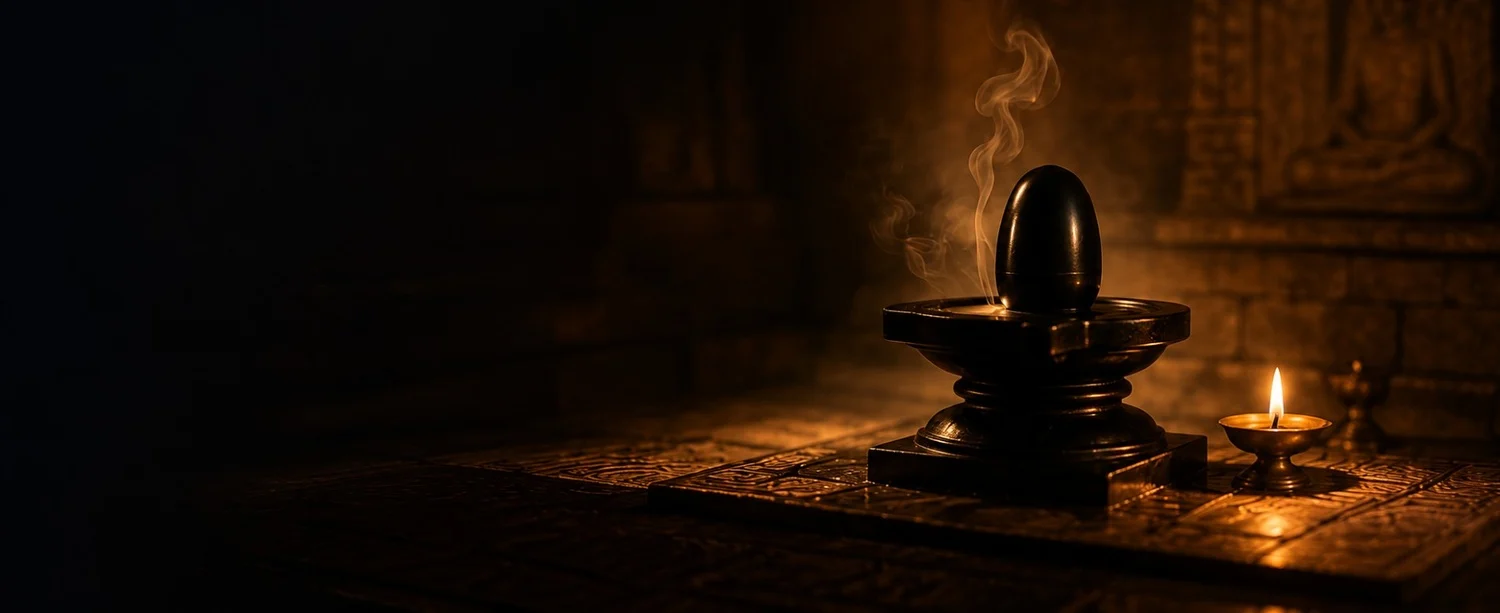
The Ishtalinga, on which the practitioner gazes during the practice of Shiva-yoga, provides the requisite lens for opening the third eye. During practice, the Ishtalinga is placed on the palm of the left hand. It is made of a light grey slate stone covered with a durable paste. This coating is blue-black or indigo, the colour of the Ajna Chakra. The mutual colours act and react on each other, enhancing the power of magnetic force. During Shiva-yoga, a light—a candle or wick lamp—is placed behind the left shoulder, and the room must be completely darkened. The hand is brought in line with the Ajna Chakra, and the aspirant gazes with half-closed eyes at the speck of light reflected in the centre of the Ishtalinga. A mantra, Om Namaha Shivay, is repeated internally. More about this will be explained in the next article.
The concentrated gaze, or 'Animisha Drishti', on the ling is essential because, through it, magnetic force is generated, galvanising the pineal gland into activity. When this activity takes place, the God-consciousness residing in it descends through the optic-thalamic nerve to unite with the individual consciousness within the pituitary gland. H.H. Shri Kumarswamiji says: “This meeting takes place in the centre between the eyebrows and brings about the efflorescence of intuitive faculties.”
This meeting takes place in the centre between the eyebrows and brings about the efflorescence of intuitive faculties.
Facing Oneself
The whole aim of Shiva-yoga is to transcend the symbol through the symbol. When the gaze is unblinking, the distinction between subject and object, within and without, is lost, and the aspirant becomes identified with the truth. The aspirant begins to see their own face, which means beginning to see oneself as one truly is. One must face the darkness as well as the light within oneself. Only then can one know oneself; that is, become self-realised.
The difficulty we all experience in facing the truth within ourselves is why self-realisation is hard to attain. Facing the truth within oneself means taking responsibility for one's own actions and not laying them at the feet of external circumstances or some external entity. All the forces of light and darkness exist within consciousness and are not external to it. The concepts of external and internal are only artificial distinctions brought about by the mind. However great or vast its powers may be, intellectual knowledge is indirect, proceeding through analysis and discursive because of its tendency to separate.
Since I was a young child, I have had clairaudient and clairvoyant experiences. On many occasions, those who were speaking to me told me, “We are in your pineal gland.” As a child of eight, I was told I would be given a 'stone' to place in my left hand, and that this would help me to know myself. This has indeed come true through my practice of Shiva-yoga.